Assemblies, Slings & Rigging
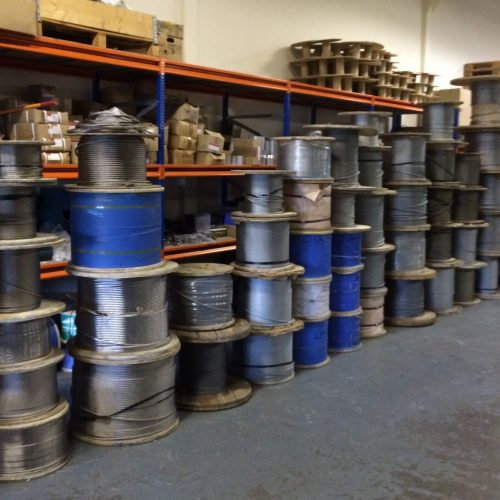
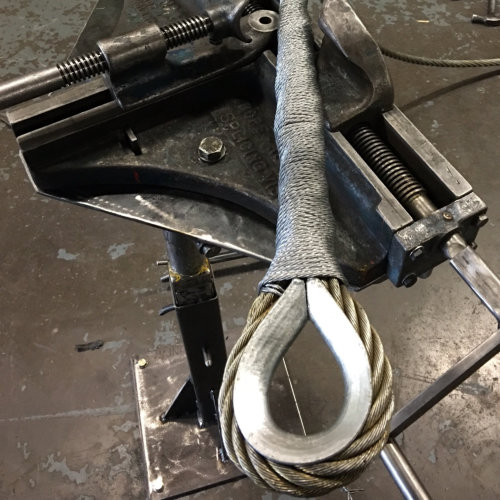
Mainco manufacture wire rope assemblies, slings, in galvanised, stainless steel and PVC covered wire ropes from 1mm diameter to 42mm diameter.
With soft eyes, thimbles eyes, swaged threaded adjusters in zinc plated and stainless steel, swaged Fork & eye terminals, rigging screws etc.
Mainco also manufacture hand splicing of all ropes from 2mm – 26mm, including Drive ropes, Ferris Wheel ropes.
An Example of:-
Wire Rope: A heavy-duty cable made of braided metal strands, designed for high tensile strength.
Swaged Fitting: A metal sleeve (often stainless steel) that has been cold-formed or “swaged” onto the end of the wire rope using a high-pressure hydraulic press. This creates a permanent, high-strength connection.
Threaded Stud/Terminal: The end of the fitting likely features a threaded section, which allows the cable to be tensioned or attached to a fixed point, such as a structural post, a marine deck, or industrial machinery.
Application: These assemblies are commonly used in:
Architectural Rigging: Such as cable railings and balustrades.
Marine Rigging: For yacht stays and lifelines.
Industrial Lifting: For overhead cranes and hoisting equipment.
Here at Mainco typically these to bespoke specifications are created using our in-house hydraulic presses (ranging from 25 to 600 tons).
An Example of:-
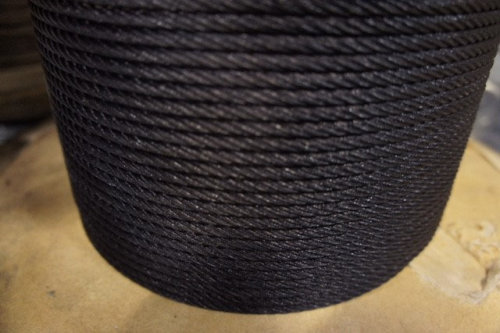
Blackened wire rope (also known as black oxide or theatre wire) is used primarily for its visual properties rather than structural ones. While it has the same strength as standard galvanised steel, the chemical blackening process makes it ideal for specific industries.
Here is why you would want blackened wire rope:
1. Low Visibility (“Invisible” Rigging)
The most common reason for blackening a rope is to make it “disappear” against a dark background.
Theatres and Stages: It is the industry standard for hanging scenery, lighting rigs, and sound equipment. Because the ceiling (the “grid”) and the wings of a stage are usually painted black, blackened wire becomes almost invisible to the audience, maintaining the “magic” of the performance.
Concert Venues: Used to fly line-array speakers and lighting trusses so the focus remains on the artist and the light show, not the support cables.
2. Non-Reflectivity
Standard galvanised or stainless steel wire rope is shiny and reflects light. In environments with intense spotlights:
Anti-Glare: Blackened wire has a matte finish that does not catch or reflect light. This prevents “hot spots” or distracting glints from reaching the audience or the camera during a live broadcast.
Photography and Film Studios: It ensures that lighting remains controlled and doesn’t bounce off the rigging into the lens.
3. Aesthetics and Display
In retail and architectural design, blackened wire is chosen for its sleek, modern look.
Retail Displays: Shop windows often use blackened wire to hang products or signage because it looks more “premium” and discreet than silver-coloured industrial wire.
Interior Design: It is increasingly used in modern “industrial” style interiors for hanging lights or shelving where a raw, dark metal aesthetic is desired.
4. Identification and Safety
In some industrial settings, blackening is used as a way to distinguish specific cables from others.
Safety Bonds: In the UK entertainment industry, “safety bonds” (the secondary cables that stop a light from falling if the primary clamp fails) are often blackened so that riggers can quickly identify that the secondary safety is in place.
Important Note on Performance:
Corrosion Resistance: The chemical blackening (black oxide) is primarily a surface finish. It offers some minor protection, but it is not as weather-resistant as hot-dipped galvanised or stainless steel. Because of this, blackened wire rope is almost exclusively used indoors.
Flexibility: The blackening process does not change the flexibility or the breaking load of the wire, so a 3mm blackened wire will have the same weight-bearing capacity as a 3mm standard wire.
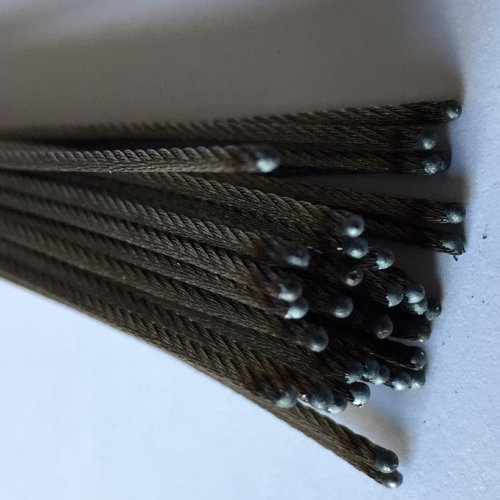
Welded (or more accurately, fused and tapered) ends are a professional finish used on wire rope to prevent the individual strands from unraveling, splaying, or fraying after the rope is cut.
In the image you linked f, you are seeing the result of a process called Annealing.
Benefits of Anealing
1. Easier Installation (Reeving)
Because the end is slightly tapered and solid (rather than blunt or frayed), it is much easier to feed the rope through pulleys, blocks, or tight openings. This is particularly critical for:
Crane Ropes: Feeding a long line through a complex boom or hoist system.
Wedge Sockets: The tapered end fits smoothly into the socket, ensuring the “live end” of the rope doesn’t snag during setup.
2. Prevents Unraveling
Standard wire rope is under tension from the way the strands are twisted. If you cut it with a saw or bolt cutters, the end will “bloom” or splay out like a paintbrush. Fusing the ends welds all the individual wires into a single solid point, keeping the rope’s structure perfectly intact.
3. Safety and Handling
No Sharp Wires: Frayed wire rope ends are notorious for causing “stabs” or cuts to riggers’ hands. A welded end is smooth and safe to handle.
No Temporary Whipping: Instead of using electrical tape or wire “seizing” to hold the end together (which can fall off or get stuck), the weld is a permanent part of the rope.
4. How it’s Made
The process doesn’t usually involve a traditional welding torch. Instead, a specialist machine (an annealing machine) clamps the rope between two electrodes and passes a high electrical current through it. As the steel reaches a white-hot temperature, the operator twists and pulls the rope, causing it to stretch and eventually break at the heated point, leaving behind that characteristic smooth, conical tip.
Important Limitation:
It is not a load-bearing termination. While the end is “welded,” this finish is only for handling and installation. You cannot hang a load directly from a welded tip. To support weight, the rope still requires a proper fitting like a swaged sleeve, a thimble and eye, or a socket further up the line.